Overview
Around the globe, companies are developing and releasing standalone AI products – but what options exist for non-developers who want to build their own AI tools? AI platforms such as OpenAI’s ChatGPT, Google Cloud Platform and Microsoft Azure AI are just a few of the options available for individuals with no prior developer experience to build, deploy and manage AI tools. Another option designed with educators in mind is the AI platform, Cogniti.
This article is the seventh in a series titled “AI in Education”, aimed at education providers interested in AI. The intention is for this series to act as a beginner’s guide to the use of AI in education, with a particular focus on AI agents. This series is being developed as part of a project to develop an AI agent for learner oral assessment, funded by the Food and Fibre Centre of Vocational Excellence. We invite you to follow along as we (Scarlatti) document our learnings about this exciting space.
The following article provides an overview of Cogniti, a generative AI platform that enables educators to create their own AI agents. We acknowledge that other similar tools are emerging (e.g., Mindjoy), however, these appear to be less well-known in Aotearoa. Therefore, we focus here on Cogniti. In this overview, we look at examples of the AI agents that have been created using the platform and how you might decide if it is right for your learners, organisation and content.
Introducing Cogniti
Cogniti is a generative AI platform designed to enable educators to build custom AI agents. Since its soft launch in October of 2023, educators from 30 institutions in Aotearoa, Australia and Singapore have produced more than 600 AI agents through the platform. Last year (November of 2024), they held a Cogniti Symposium, showcasing the various use cases of Cogniti-based AI agents and garnered interest from over 3,000 registered attendees.
Cogniti features and users
We have reviewed the Cogniti website, news articles that mention Cogniti, and a recent Cogniti symposium programme agenda to further under Cogniti’s features and users.
This review suggests that Cogniti can be used to develop AI agents that:
- Support delivery – Cogniti can be used to make agents that act as tutors, note-takers, mentors, writing assistants or to conduct roleplays. It can also create multiple-choice questions to support student learning, but it does not seem to have been used to conduct formal assessments.
- Cover diverse topics - Educators can use Cogniti to build agents across a wide range of subject areas, adapting them to different curriculum needs and learner levels. For example, it has been used in beauty therapy, chemistry, legal studies and nursing.
- Are text-based – Cogniti can be used to make AI agents that convert speech-to-text and text-to-speech, but these capabilities do not appear to have been adopted at scale yet, with no examples found of oral AI agents created through Cogniti.
- Integrate with other platforms – Cogniti can be integrated into learner management systems (LMS) on a per-organisation basis. As of December 2024, Cogniti-designed AI tools can be integrated into Canvas and Moodle, and they are developing the ability to integrate it into Blackboard.
- Aim to address data privacy and ethics – Cogniti has voluntarily adopted the Australian government’s AI ethics principles, and built several privacy safeguards built into the platform – although it is up to the educator making the agent on how they manage these (e.g., ensuring they are following local policies etc). Cogniti includes links on their website, for educators to learn more about further best practices.
This review also suggests that Cogniti users are:
- Non-developers – Cogniti is designed for people with no prior developer experience to build, deploy and manage the AI tools they create through the platform.
- Universities (mostly) - Of the 30 AI tools featured in the Cogniti symposium late last year, 25 tools were created by universities. The other 5 tools were created by colleges (2), schools (1) and vocational education and training (VET) providers (2). Assuming this sample is representative of Cogniti’s wider use, it means that very few are being made by VET providers.
Given this, the platform seems most suitable for educators wanting tools to help enhance delivery of learning (e.g., via tutors, mentors, etc), and to do so via writing. At this stage, formal assessments (via writing or oral) may require a custom AI agent.
Deciding what type of AI tool is right for you
The below flowchart is a starting point for deciding which type of tool (e.g., Cogniti or a custom agent) as well as which format (written or oral) might be best for your students, organisation and content.
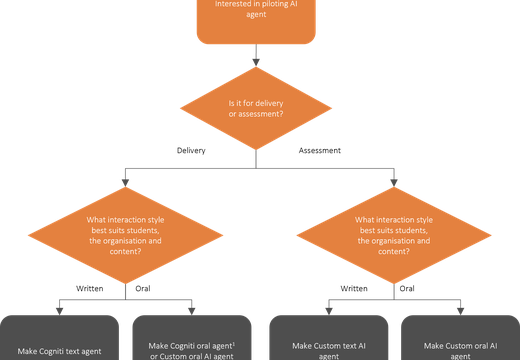
[1] As mentioned earlier, this functionality exists but does not appear to have been used widely.
Scarlatti’s take
Cogniti is a powerful platform to create AI agents for use in education. So far, it seems best suited for agents that support the delivery of learning and are text-based. However, we see a strong value proposition for oral assessment agents for the VET sector. We think this because in VET (in comparison to universities):
- Learners have greater challenges with writing
- Learners are often not on campus and therefore less available for in-person assessments
- Assessments often involve demonstrating specific applied knowledge with clear right and wrong answers, like the application of real regulation (rather than generic skills, like problem-solving).
An AI agent capable of conducting oral assessments could help bridge these challenges by enabling learners to demonstrate competency verbally, in a flexible, accessible, and supportive way. It may also allow assessors to efficiently verify understanding without the need for time-consuming written submissions, aligning more with the practical nature of VET education.
Questions that we are asking for our own AI agent:
- What student, organisation and content characteristics make traditional or AI delivery or assessment more suitable?
- What student, organisation and content characteristics make a written or oral delivery or assessment more suitable?
Interested in following our journey into AI?